Economy in Italy
From economic power to a country of problems
Even in the early Middle Ages, Italy experienced an economic boom. Powerful city states like Genoa and Venice achieved a dominant position in the Mediterranean area and saw their maritime trade prospering. However, with the decline of the great economic powers in Italy and domestic discords the country fell behind its European competitors and saw the gap widen constantly. Today, Italy is an industrialised country that still suffers from the consequences of a highly controlled economy. The economic imbalance between northern and southern Italy and the traditionally high level of shadow economy leave the country suffering.
Economic power in the Middle Ages
Italy has already been an economic centre in Europe in ancient times. The economic downturn began with the fall of the Roman Empire, a downturn that was halted during the Middle Ages, at least in northern Italy. Two powerful city-states - Genoa and Venice - gained supremacy in the Mediterranean area and established a flourishing maritime trade. Prosperity and wealth disappeared, however, as the influence of the two trading powers weakened, and finally disappeared due to the wars and conflicts connected with the establishment of Italy as a nation. During the colonial era, the newly formed Italy failed to keep up with the great European powers and was thus eclipsed, not only by its internal political conflicts. The economic dominance had become history.
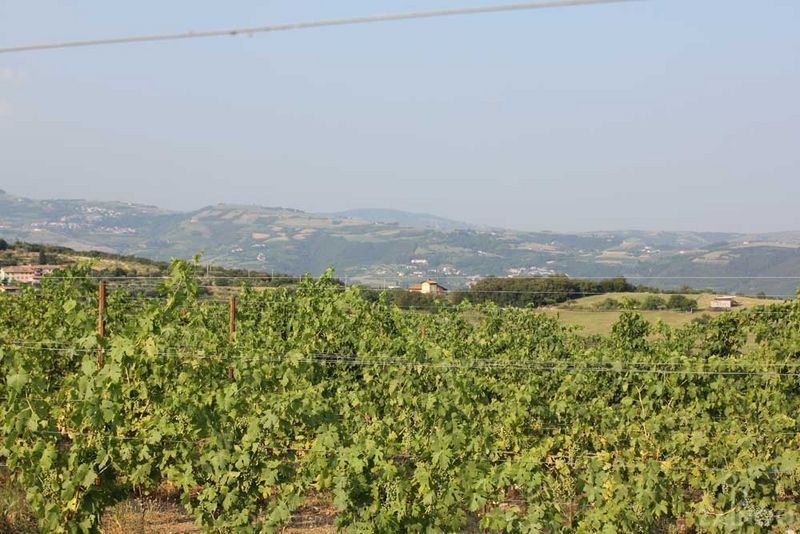 Vines in Veneto
Economy in Italy: industry and agriculture
As in most countries of Western Europe, agriculture is in a continuous decline in Italy. Italy is a country of scarce resources and with only a few notable natural resources. On an agricultural level, the south maily cultivates wheat, tobacco, olives, stone fruit, sugar beets and tomatoes, while northern Italy has a strong tradition of pig and cattle breeding. The cultivation of wine, however, is widely spread throughout Italy and one of the country's major export commodities.
The Italian Industry and economy in Italy are strongly nationalised - a circumstance that only slowly starts to dissipate as waves of privatisation wash over the country. While most workers in the south are employed by small businesses, the richer north is home to many large corporations employing a far larger total workforce.
Economy in Italy today
Almost 70% of the Italian GDP are generated in the service sector. Tourism plays a very important role for the Italian economy and contributes nearly 10% to this sector. In recent years, some 40 million tourists a year visited the country. Beaches in northern Italy aside, the most important destinations are Venice, South Tyrol and Rome. Nevertheless, the country, like many other European destinations, is still struggling with a decline in overnight stays after the tourist boom of the last decade.
Tweet